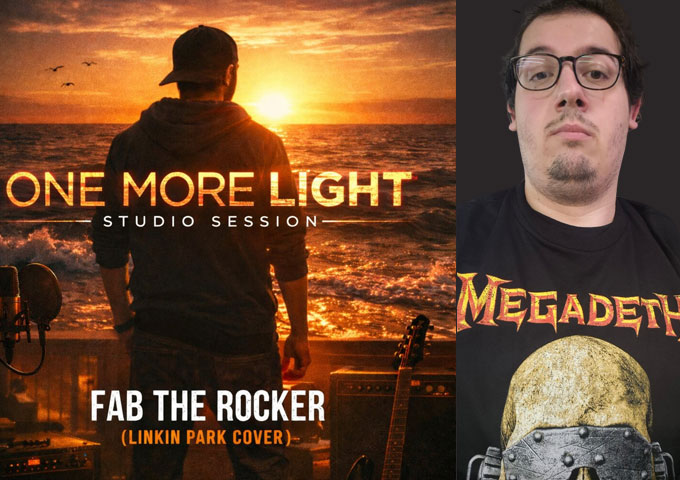

There are songs that exist as polished monuments to emotion, and then there are the versions that tear those monuments down and show you what was buried underneath. Fab The Rocker’s cover of “One More Light” belongs firmly in the latter category, a performance so emotionally unguarded that it feels less like a cover and more like a confession.
The South London artist has built his reputation on exactly this kind of raw, unfiltered storytelling. Raised in Stockwell, a neighborhood affectionately known as “Little Portugal” for its vibrant multicultural heartbeat, Fab The Rocker came up absorbing the textures of street life, displacement, and personal struggle. Those experiences didn’t just inform his music; they became the music itself. Drawing from the well of ’90s alternative rock giants like Nirvana, The Offspring, and Soundgarden, he has developed a sound that carries the grit and moral honesty of that era while remaining unmistakably his own. Rough-edged vocals, lyrics that pull no punches, and a willingness to sit inside discomfort without flinching are the hallmarks of his artistry, one that has also been tempered by serious personal health challenges, adding yet another layer of hard-won authenticity to every note he sings.
His ability to reimagine existing material was first signaled through powerful covers of tracks like “Gone Away” and “Life’s For The Living”, performances that demonstrated an instinct for finding the emotional marrow inside a song and drawing it out with surgical intensity. That same instinct is now applied with devastating effect to one of rock music’s most quietly shattering compositions.
“One More Light” is the title track from Linkin Park’s seventh studio album, released on May 19, 2017, through Warner Bros. Records. The album itself represented a significant artistic pivot for the band. Where previous records were scaffolded by Chester Bennington’s feral screams, heavy guitar work, and sonic pyrotechnics, One More Light was a deliberate step into more vulnerable, pop-adjacent territory. Notably, it was the first Linkin Park album to carry a title track, and that was no accident. The band considered “One More Light” the emotional core, the very heartbeat of the record. It was also the final album to feature both Bennington and co-founding drummer Rob Bourdon, who chose not to return when the band reformed in 2024.
Written by Mike Shinoda and Francis White, the song was originally conceived as an act of love for a woman connected to the band’s label who had passed away. It was grief given melody, a gentle but insistent argument against the world’s tendency to minimize individual loss in the face of overwhelming scale. Then, on July 20, 2017, just two months after the album’s release, Chester Bennington died by suicide, and the song’s meaning was irrevocably rewritten by tragedy. Shinoda acknowledged in the aftermath that the band found themselves on the receiving end of the very comfort they had tried to offer others. The song became a eulogy for the man who had sung it. In a candid 2025 interview with The Guardian, Shinoda revealed that “One More Light” would no longer be performed live, describing the prospect as simply “too sad,” a reflection of how completely the song had become entwined with Bennington’s memory.
It is into this extraordinarily weighted context that Fab The Rocker steps, and he does so with both humility and courage. His version is stripped to its most essential elements: resonating piano chords and a voice that seems to float and fracture simultaneously, as though it were echoing across an enormous, empty space. Where the original wrapped its grief in the warm sheen of pop production, Fab removes all of that gleam and leaves the listener with something altogether more exposed. The result carries a visceral melancholy that paradoxically intensifies the song’s power rather than diminishing it.
Lyrically, “One More Light” is a masterclass in restrained devastation. It opens with a quiet avalanche of guilt and retrospection, the narrator wrestling with whether warning signs were missed, whether intervention was possible, whether love alone could have been enough to redirect fate. These are the questions that haunt every person left behind by sudden, incomprehensible loss, and Shinoda and White articulate them with an almost unbearable gentleness.
The song’s central challenge to indifference, asking who could possibly care if one more light extinguishes in a sky containing millions, is not rhetorical cruelty. It’s a mirror held up to the way collective grief can feel abstract and dismissible, before the song quietly, firmly answers its own question: “Well I do.” It is one of the most understated and emotionally complete responses in modern songwriting. In a cultural moment that often rewards spectacle, those two syllables carry more weight than an entire arena of sound.
The second verse deepens the wound with unflinching domestic detail. A kitchen with one more chair than is needed, a space where absence becomes physical, occupying the room as solidly as the person who used to fill it. The acknowledgement of anger is equally important here. Rather than counselling acceptance or transcendence, the song validates fury as a legitimate and reasonable response to unfair loss. Grief, it argues, is not a problem to be solved but a presence to be reckoned with.
Fab The Rocker understands all of this intuitively. His vocal delivery does not attempt to beautify the song or sand down its rougher emotional edges. If anything, it leans further into the ache, his voice carrying the unmistakable quality of someone who has genuinely looked loss in the eye and refused to look away. His personal journey through health struggles and hardship has given him a relationship with vulnerability that is rare, and it translates directly into the authenticity of this performance.
What makes this cover remarkable is its refusal to compete with the original or to reframe it as something other than what it is. Fab The Rocker honors Linkin Park’s original sonic vision while simultaneously making the song entirely his own through the sheer force of emotional presence. He doesn’t attempt to replicate Bennington’s extraordinary instrument; he responds to it, the way one voice might answer another across a great distance of shared grief.
In choosing to cover “One More Light”, Fab The Rocker has done something that requires real artistic courage: he has entered a space of profound communal pain and offered something genuinely personal within it. The performance stands as both a tribute to Chester Bennington’s legacy and a statement about Fab’s own artistic identity, an identity built on the conviction that honesty, however uncomfortable, is always worth more than polish.
As he continues to build towards new original material, this cover serves as a compelling reminder of the depth of feeling he brings to everything he touches. Fab The Rocker is not simply an artist on the rise. He is an artist who already knows exactly who he is.
OFFICIAL LINK:
BANDCAMP: https://fabtherocker.bandcamp.com
SPOTIFY: https://open.spotify.com/artist/003NeV3sH7BMOb2zG5ABIl
INSTAGRAM: https://www.instagram.com/FabTheRocker
YOUTUBE: https://youtube.com/@fabtherocker