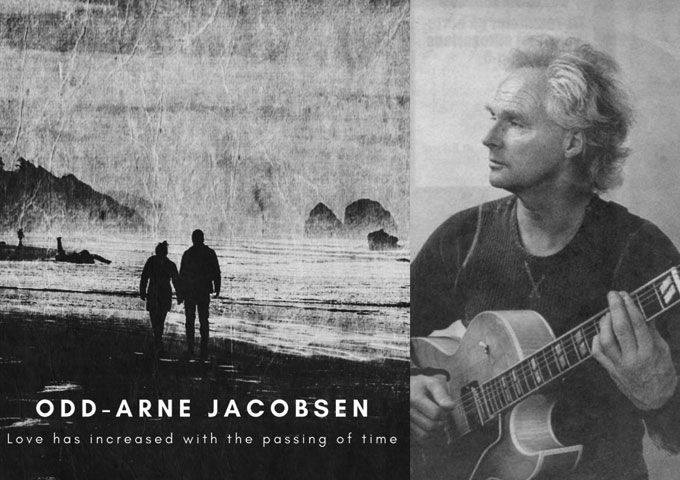

Some artists accumulate a career. Others build a world. Norwegian guitarist and composer Odd-Arne Jacobsen belongs firmly to the latter category, and with the forthcoming remastered re-release of his solo album Love Has Increased With The Passing Of Time on the 20th of April 2026, that world is about to become available to a whole new generation of listeners, with a clarity and depth befitting its extraordinary content.
To understand why this release matters, you need to appreciate the sheer breadth of the man behind it. Odd-Arne Jacobsen has spent decades carving out a position as one of the most distinctive and adventurous voices in European improvisation music, a position earned not through imitation but through relentless creative independence. In the early 1970s, he toured alongside the legendary saxophonist Jan Garbarek, bassist Arild Andersen, and Finnish percussionist Edward Vesala, a constellation of talent that would have seduced most guitarists into the orbit of ECM Records and its celebrated aesthetic. Jacobsen chose a different path entirely, following his own instincts toward Japan, China, and musical territories that would quietly but permanently reshape his tonal language.
That independence has defined everything since. He has toured across the United States, Mexico, Russia, France, China, Kuwait, Scotland, and Japan. He performed as a guest solo artist at the Moscow International Jazz Festival alongside Alexei Kuznetsov’s quartet and held his own television program in Russia, Vinter nattens hemmeligheter, bringing his music into living rooms from St. Petersburg to Siberia. He is one of a select few Norwegians to have toured with alto saxophonist Arne Domnerus and the revered Swedish jazz guitarist Rune Gustafsson, with whom he also performed a memorial concert for the great Robert Normann in Sarpsborg. And in 1990, he achieved something no Norwegian guitarist had ever done before, standing alone on the stage of Weil Recital Hall at Carnegie Hall in New York, performing his own compositions to an audience who witnessed something genuinely singular.
This is the artist who now presents a remastered edition of Love Has Increased With The Passing Of Time, and context, in this case, is everything. The album is a solo acoustic guitar recording, unaccompanied and unadorned, and it is precisely this nakedness that makes it so breathtaking. Jacobsen has chosen to explore three classic compositions, reimagining each through his own harmonic and rhythmic sensibility, not as an act of appropriation but of deep, respectful conversation. He takes familiar materials and breathes new life into them with the quiet authority of someone who has spent a lifetime listening to what music actually wants to say.
Consider his reading of “I Hope It’s Spring For You”, originally composed by the Swedish baritone saxophonist, pianist, and composer Lars Gullin. In Odd-Arne Jacobsen’s hands, the piece feels as though it could not possibly have been written for anyone else. His melodic instinct is so finely attuned, his harmonic choices so naturally integrated, that he doesn’t so much perform the composition as inhabit it. This is the hallmark of a musician who has moved beyond technical command into something rarer and more elusive, genuine interpretive wisdom.
Then there is “Manhã de Carnaval”, a piece with a remarkable history of its own. First introduced as the central theme of the 1959 Portuguese-language film Orfeu Negro, this award-winning composition is widely credited with helping to establish the Bossa Nova movement and has since become one of the most enduring jazz standards in the repertoire. Jacobsen’s treatment is graceful and unhurried, carrying within it a kind of luminous melancholy that feels entirely his own. He understands that this music does not need embellishment, only a player sensitive enough to let it breathe.
The third piece, “Here There and Everywhere”, written by Lennon and McCartney, might seem on the surface like an unexpected choice, but in Jacobsen’s hands it reveals its deeper harmonic richness with ease. The song’s devotion and emotional intimacy, that sense of love as something total and quietly urgent, translate with remarkable naturalness into his fingerpicked phrases. He finds the architecture within the song and rebuilds it in his own image.
This is precisely the quality that makes Odd-Arne Jacobsen so remarkable as an interpreter. His playing has the cohesion and spatial logic of great architecture. Each phrase connects to the next with purpose and grace, forming structures that feel inevitable in retrospect yet surprising in the moment. Listening to him is to understand that the guitar, in the right hands, can sustain an entire emotional universe without a single accompanying instrument.
Before the remastered album arrives, it is worth pausing to acknowledge last year’s EP “Between Days,” a collaboration with fellow guitarist and composer Tore Morten Andreassen, currently available on all major platforms. Where Love Has Increased With The Passing Of Time is a solo meditation, Between Days is a dialogue, six pieces built from shared improvisation, interweaving solos, and the kind of telepathic chord progressions that only emerge when two musicians are genuinely listening to one another. Hearing this EP is something like eavesdropping on a private conversation conducted in a language you cannot speak but somehow understand, catching the emotional weight of each exchange even when the grammar eludes you. It is intimate, generous, and deeply felt, a document of two distinctive voices meeting in real time and discovering what they can build together.
Odd-Arne Jacobsen has also distinguished himself as a composer beyond the confines of jazz and improvisation. His piece Music for the Silence Minority, written for guitar, string quartet, and bassoon, received its premiere at an exhibition featuring works by Edvard Munch and Gustav Vigeland at the Munch Museum in Oslo, a setting that speaks volumes about the kind of artistic company his work is considered fit to keep. He also opened Nordlysfestivalen in Tromsø in January 2007 and premiered his string and guitar work For Strings Only with the MIN Ensemble and Edvard Debess, continuing to push into new compositional territory with the same curiosity that has always defined him.
The remastered Love Has Increased With The Passing Of Time arrives, then, not as nostalgia but as revelation. It is the work of a true craftsman, fully committed, quietly extraordinary, and playing at the absolute height of his powers. The 20th of April 2026 cannot come soon enough.