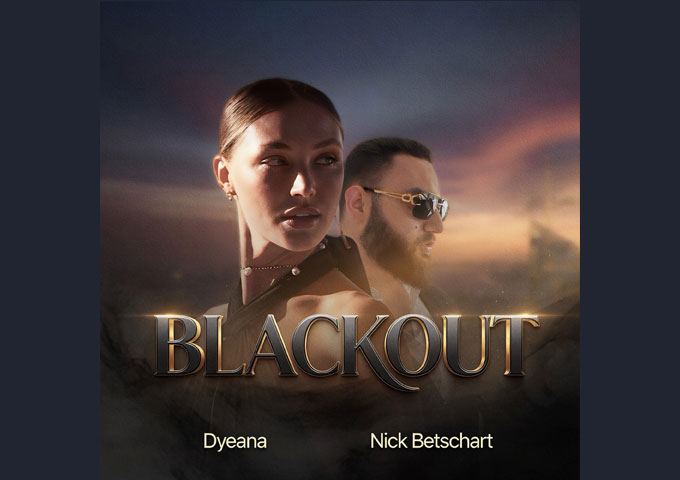
Four tracks. Four distinct emotional crises. One of the most cohesive and compelling EPs of the year. The Swiss duo have delivered a release that doesn’t decorate pain — it measures it.
Some records carry the unmistakable weight of artists who know exactly what they want to say and precisely how they want to say it. Blackout, the debut EP from Swiss musician, songwriter and producer from Aargau, Switzerland, Nick Betschart, and vocalist Dyeana, is one of those records. Released through R3cords Three Production Studios, this four-track collection announces two artists at a compelling creative intersection: emotionally raw enough to disarm, and sonically ambitious enough to command serious attention.
Built around cinematic rock, alternative pop, and pop-rock energy threaded through with electronic textures and dramatic songwriting, Blackout is not an EP that traffics in vague melancholy. Its darkness has coordinates. It deals in the specific, devastating topology of moments that cannot be reversed: a fatal accident logged to the minute, a betrayal that erodes every last trace of empathy, a breakup replayed on a solitary late-night drive, and the invisible structural pressure that begins destroying long before anyone realizes the damage is already done. The title is not merely evocative. It describes a state, the sudden failure of emotional infrastructure, the moment certainty disappears and the space between shock and survival becomes the only territory left to navigate.
What makes Blackout stand apart from a crowded field of emotionally charged pop-rock releases is its absolute refusal to soften the subject matter. These songs do not comfort. They document, they weaponize, they question, and they let the wreckage echo outward. The result is a compact emotional sequence that moves through impact, freeze, aftermath, and pressure with the momentum and inevitability of something geological. By the final track, grief has become measurable through sound, speed, temperature, and mass.
Nick Betschart and Dyeana also bring an exceptional vocal chemistry to the project. Their voices move between intimacy and scale with ease, switching leads, joining in chorus, trading verses, and occasionally delivering something closer to spoken pressure than traditional melody. The interplay is never decorative. It serves the emotional architecture of each track with a confidence that belies Betschart‘s 24 years, and speaks to a genuine artistic partnership built on shared intensity and mutual trust.
The EP opens with “4:07”, and it does not ease you in gently. This is a track that takes a specific timestamp and turns it into a permanent wound, contrasting the texture of ordinary domestic life, folding laundry, making dinner, with the irreversible violence of a fatal car accident. Nick Betschart and Dyeana trade verses before meeting in bridges and choruses for a performance that is genuinely exhilarating in its vocal range and devastating in its emotional honesty. Where other songs about grief reach for comfort, “4:07” reaches for something more difficult: the ongoing, grinding weight of survival, the act of rebuilding a broken world every single morning without any promise that the effort will get easier.
“Absolute Zero” moves the temperature in a different direction. This is where grief becomes cold and confrontational, where repeated betrayal and psychological manipulation finally exhaust the last reserves of forgiveness. Nick Betschart leads the vocal charge with a ferocity that is remarkable in its control, joined by Dyeana in a harmonic chorus that feels less like resolution and more like a reckoning. The track uses sub-zero imagery to capture the precise moment empathy rots completely away, leaving behind something calculated, implacable, and engineered entirely by the abuser’s own cruelty. There is no heroic salvation here, no comfortable arc toward healing. Just a debt paid in full, and the quiet that follows.
“A Million Last Words” brings a different kind of desolation. Where “Absolute Zero” weaponizes pain, this track is consumed by it, specifically by the particular cruelty of grief’s retroactive eloquence: all the things that only become perfectly articulable after the moment to say them has closed forever. Dyeana opens with an anthemic vocal performance that sets the emotional register immediately, before Nick Betschart takes over with assured, introspective interludes. The setting, a late-night drive against an indifferent backdrop, turns the song into a psychological echo chamber where regret does not fade but instead sharpens, and the most important truths a person ever needed to say are shouted only into the empty dark of a lonely highway.
The EP closes with “Subsonic”, and it is the moment Blackout expands its emotional vocabulary to something almost geological in scale. Using infrasound, pressure waves, and structural collapse as extended metaphors, the track captures the terrifying window of time when animals flee and architecture buckles before any human mind has registered that something catastrophic is happening. Dyeana again leads the vocal charge, moving between soaring melodic passages and edgy rapped lines with remarkable range, before sharing the track with Nick Betschart, who demonstrates his own ability to shift between singing and rapping with equal conviction. “Subsonic” is thrillingly industrial and high-velocity, but its deepest power lies in what it articulates about aftermath: that the true measure of a crisis is not the noise it makes, but the devastating void it leaves behind.
As a combined statement, Blackout is the work of two artists who understand that emotional honesty requires structural precision. Nick Betschart, whose music has always blended modern pop-rock with electronic energy and cinematic atmosphere, finds in Dyeana a creative counterpart whose voice brings exactly the contrast and intensity the material demands. Together they have made something that does not ask for your sympathy so much as it insists on your full attention. The damage in these songs continues to move long after the first visible break, and that is precisely the point. Blackout does not end when the music stops. It simply goes quiet.
OFFICIAL LINKS:
https://www.instagram.com/dyeana1d
https://www.tiktok.com/@dyeana.d
https://www.instagram.com/nick.bt_
https://www.tiktok.com/@nick.bt_
https://open.spotify.com/artist/2j3S6x5oizMVgOhXqGzgQt
https://open.spotify.com/artist/0dgwJIsZfpsCfewGF2Fv8C
https://distrokid.com/hyperfollow/nickbetschartdyeana/blackout/