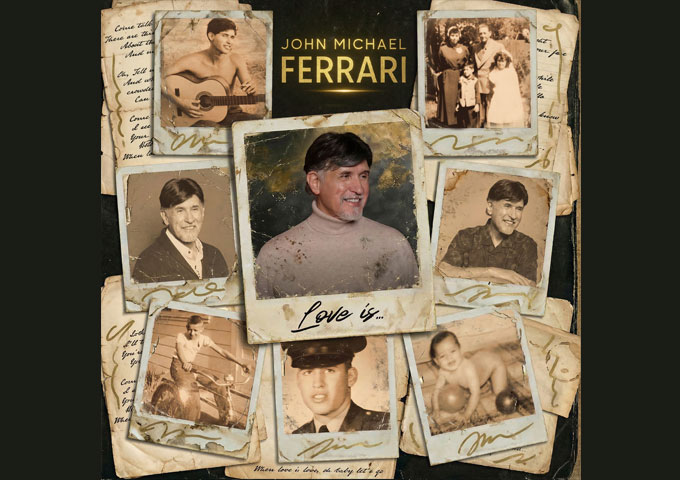
With ‘Love Is…’, John Michael Ferrari turns twelve songs into a deeply personal exploration of devotion, longing, memory, and connection. His warm vocal delivery provides the emotional thread that carries the album from its opening moments through its final notes. Pepper Jay’s production allows classic romantic arrangements and contemporary Americana textures to coexist naturally. Ferrari approaches each song with an emphasis on honest storytelling rather than unnecessary musical or lyrical excess. The result is an album shaped by sincerity, melodic craftsmanship, and a genuine belief in the enduring power of love.
John Michael Ferrari understands something increasingly rare in contemporary songwriting: romance does not need to be complicated to be compelling. Sometimes the most powerful declaration is simply an honest one, delivered by a voice that sounds as though it has lived through every emotion it is singing about. On ‘Love Is…’, Ferrari places that philosophy at the heart of a 12-song collection devoted to the many dimensions of love, from desire and devotion to separation, remembrance, companionship, and the almost transcendent happiness of finding someone who makes life feel more complete.
An award-winning singer-songwriter and recording artist, Ferrari has developed a musical identity that draws naturally from contemporary country, Americana, pop, and the grand tradition of the American crooner. His voice is warm, powerful, smooth, and deeply communicative, allowing him to inhabit romantic lyrics without making them feel artificially sentimental. Instead, he gives them the weight of personal experience. Working alongside longtime collaborator and producer Pepper Jay, Ferrari has created an album that feels deliberately rooted in the tradition of classic songwriting while remaining accessible to modern listeners.
The physical presentation reinforces that sense of permanence.’ Love Is…’ is being offered as a limited-edition vinyl collection of only 1,000 individually signed and numbered copies, with no reprint planned. Produced by Pepper Jay under Cappy Records and mixed by David Buchanan at Beaird Music Group in Nashville, the album is conceived not merely as a collection of digital tracks but as a complete listening experience. Ferrari and Jay wrote the majority of the material together, while “When Love Is Love” was written by John Michael Ferrari, Pepper Jay, David Easterling, and Sophie Love.
Musically, the album immediately establishes its affection for the golden age of sophisticated romantic songwriting. “When Love Is Love” opens with electric piano, clean guitar, and a gently shuffling drum pattern that creates a relaxed jazz-lounge atmosphere. Ferrari enters with the kind of commanding croon associated with classic American vocalists, but his delivery never becomes an exercise in nostalgia. The Americana sensibility beneath the arrangement gives the song a contemporary identity, allowing Ferrari to sound both timeless and unmistakably himself.
The lyrics establish one of the album’s central ideas: genuine love is recognizable because it is authentic. The song presents love as something that can be felt, understood, and lived. Ferrari’s phrasing gives the sentiment considerable warmth, transforming what could have been a simple declaration into an inviting opening statement for the entire record.
That emotional honesty becomes more poignant on “Already Miss You.” Shimmering electric and acoustic guitars provide a delicate foundation while background vocals deepen the sense of intimacy. The song explores the separation between a father and daughter, shifting the album’s definition of love beyond romantic partnership. Its emotional force comes from the contradiction at its center: someone can be physically absent while remaining overwhelmingly present in memory. Ferrari does not overplay that longing. His vocal performance allows the ache to emerge gradually, making the song’s sense of absence feel lived rather than manufactured.
On “Yes, I Do,” Ferrari returns to romantic commitment with a slow-burning arrangement colored by jazz and lounge influences. Guitars and strings surround his yearning vocal, creating an atmosphere that feels intimate without becoming claustrophobic. The repeated affirmation at the center of the song is important precisely because of its simplicity. Ferrari is not searching for an elaborate metaphor to prove devotion. He keeps returning to the essential answer, giving repetition the emotional function of a promise.

“Paint You A Love Song” expands that romantic vocabulary through imagery of creating something beautiful for another person. Picked acoustic guitar and piano establish an intimate foundation before the arrangement opens outward. The lyric’s central metaphor suggests that love can itself become an artistic creation, something made deliberately and offered to another person as a lasting expression of affection. Ferrari’s vocal interpretation keeps the sentiment grounded, allowing the song to feel personal rather than overly theatrical.
The cinematic side of Ferrari’s artistry becomes especially apparent in “So Beautiful.” Acoustic guitar initially leaves plenty of room for his voice before restrained percussion, piano, and strings gradually broaden the arrangement. The lyric focuses on admiration through specific romantic details, and that specificity is crucial. Ferrari understands that believable love songs are often built from small observations rather than grand declarations alone.
“I Don’t Want to Love” introduces a bluesier texture, with keys, guitars, bass, and steel-string touches supporting a relaxed mid-tempo groove. Its title initially sounds like resistance, but the song’s emotional argument reveals the opposite. The narrator does not want love in the abstract. He wants one particular person, the person capable of making him feel something no one else can. That tension gives the lyric its charm, while Ferrari’s crooning delivery makes the repeated declaration sound simultaneously vulnerable and assured.
The mood brightens considerably with “One Heck Of A Girl,” an upbeat departure that injects movement and playfulness into the collection. Its jaunty rhythmic character and instantly memorable refrain present attraction without the reflective weight found elsewhere on the album. That contrast matters. A collection about love needs room for uncomplicated joy, and Ferrari supplies it with a performance that feels designed for the stage.
That performance instinct is fundamental to “You’re My Dream Girl,” where resonant keys and muted electric guitar create a slightly mysterious atmosphere. Ferrari builds the lyric around the idea of recognizing an almost dreamlike romantic possibility. The imagery gives the song a hazy quality, while his vocal remains direct enough to keep the narrative emotionally grounded.
Then comes “My You,” one of the album’s most sincere vocal showcases. Ferrari sings with an evident lack of emotional armor, allowing the lyric to function almost as an intimate confession. Piano, drums, strings, and backing vocals create a polished arrangement, but the production never overwhelms the singer. Instead, the instrumentation gives his voice room to reveal its nuances.
“Music With You” changes the emotional perspective once again. Here, Ferrari celebrates the communal experience of making and sharing music, connecting romantic affection with performance, audience, and artistic fulfillment. The song’s imagery of guitar strings, radio play, applause, harmony, and singing together reflects Ferrari’s own relationship with the stage. His philosophy that there is “never a stranger in the audience” finds a natural musical counterpart here. The song suggests that connection is not only something experienced privately between two people. It can also happen collectively through music.
“Be the Smile on Your Face” continues that celebratory spirit while gradually building from a slow burn into a richer mid-tempo arrangement. Piano and acoustic guitar establish the opening, while background vocal touches help the song gather momentum. Lyrically, Ferrari focuses on the desire to make another person happier, safer, and more fulfilled. The central image of becoming the smile on someone else’s face is uncomplicated, but that is precisely why it works. The lyric defines love through action rather than abstraction: lifting someone up, changing their world, and choosing to contribute to their happiness.
The album closes with “No Mistaken,” a fitting final statement because it returns to the certainty that has quietly connected so much of the record. Piano, acoustic guitar, strings, drums, and steel lap guitar create a layered emotional backdrop, while Ferrari uses deeper tones in the verses before opening his voice into the choruses. The lyric confronts the tension of two people who may attempt to disguise their feelings but ultimately cannot escape what they know to be true.
That final idea gives ‘Love Is…’ its cohesion. Ferrari is not presenting one definition of love. He is presenting an entire emotional vocabulary for it. Love can be romantic devotion, parental attachment, separation, admiration, companionship, creative partnership, performance, memory, or the simple determination to make another person’s life brighter.
John Michael Ferrari’s music carries the elegance of classic crooning, the storytelling instincts of Americana, the melodic directness of pop, and the emotional openness of modern singer-songwriter music. Pepper Jay’s production provides a polished environment in which those elements can coexist naturally.
Though the ‘Love Is…’ is also part of Ferrari’s ongoing For Your Consideration campaign for Grammy recognition in the contemporary country field, Ferrari is pursuing something larger than recognition: the preservation of the complete album experience and the belief that songs about human connection can still matter when they are delivered with sincerity.
Here, John Michael Ferrari offers a romantic record that understands the enduring power of melody, storytelling, and an unmistakably human voice. Ferrari’s greatest asset is that he sings these stories as though the feelings are not theoretical. They are lived. That authenticity is what gives ‘Love Is…’ its lasting character.
The album does not attempt to reinvent the language of love. In John Michael Ferrari’s hands, romance becomes less about grand spectacle and more about recognition: knowing someone, missing someone, choosing someone, celebrating someone, and finding the courage to say exactly how you feel.